




























Free The Key
Logic-based gameplay of Free The Key
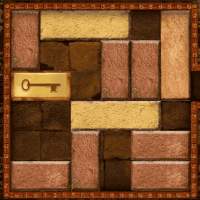
Play Free The Key to train your spatial thinking. You must move the blocks horizontally or vertically to guide a key to its portal to beat 40 levels.
Your primary missions
This game features a grid filled with a movable key and a collection of sliding blocks. There are two types of blocks in this grid.
- Horizontal blocks: can move left and right only.
- Vertical blocks: can move up and down only.
You slide these blocks within the grid to create a clear path that allows the key to reach the portal. Because movement is constrained by orientation, every block functions as both an obstacle and a tool. A block that initially blocks the key may later become the essential element of the path once repositioned. Levels are solved when the key reaches the portal. There is no direct control over the key except by moving surrounding blocks to make space or to form a corridor. Therefore, planning several moves ahead is frequently necessary. The limited movement directions and confined space encourage solutions that reuse the same blocks multiple times in different roles.
Pro strategies to win the levels
- Observe before acting: I advise you to spend time scanning the entire grid to identify which blocks are fixed by orientation and which empty spaces can be exploited. Often, the correct sequence is visible after a careful look.
- Plan several moves of the blocks ahead: Because blocks can only move in one axis, a move that seems helpful now may block a necessary future shift. Try to visualize the grid after two or three moves.
- Use empty rows and columns as staging areas: You should make and keep temporary gaps to park blocks while you reposition others. Running out of staging space often causes deadlocks.
- Prioritize freeing the key's immediate corridor: If the key can move even one or two squares toward the portal, it often unlocks new maneuvering options.
How to control: Hold the left mouse button to move the blocks horizontally or vertically.
Many levels in Free The Key
This game follows classic sliding-block puzzle design. The 40-level structure typically follows this progression:
- Levels 1 to 10: The levels introduce the two block types and basic patterns, such as clearing a straight corridor, shifting a blocking piece out of the way, and using empty rows/columns as temporary staging areas.
- Levels 11 to 20: Introduce puzzles that require multi-step chains of moves, revealing how repositioning one block can enable several subsequent moves.
- Levels 21 to 30: Present tighter grids and interdependent pieces where moving one block likely forces repositioning multiple others. These levels emphasize minimizing wasted moves and recognizing necessary sequences.
- Levels 31 to 40: Demand deeper planning and more complex rearrangements, sometimes requiring temporary sacrifices, moving a vital block into a seemingly blocking position temporarily to open a longer-term route.